

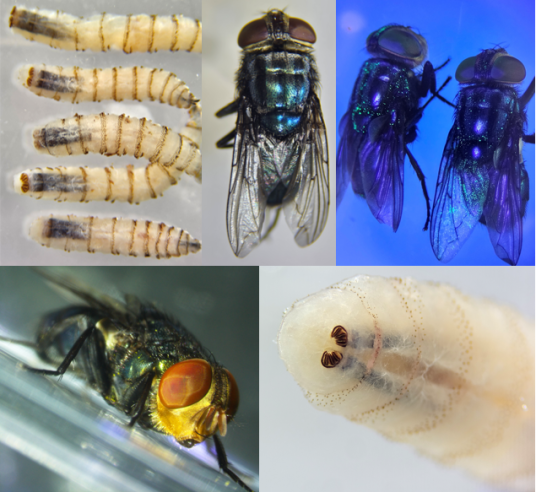
The New World screwworm (NWS), Cochliomyia hominivorax, is an iconic figure in veterinary and medical entomology. Myiasis, resulting from NWS larvae feeding on the living tissue of warm-blooded hosts, affects livestock, companion animals, wildlife, and humans. NWS was the first pest to be successfully eliminated from a region using the sterile insect technique (SIT), which was among the first peaceful uses of nuclear energy.
While SIT programs effectively pushed NWS populations southward from the United States to Mexico and, finally, to a buffer region at the border between Panama and Colombia, there has been an alarming resurgence of the NWS northward into Central America and southern Mexico, beginning in 2022. On June 3rd, 2026, the first NWS case in Texas (USA) in 60 years was identified from a bovine calf, and as of June 22nd, the number of confirmed cases in Texas has risen to 16 with detections in cattle, goats, and sheep, spanning eight counties and extending 150 miles due north from the Texas-Mexico border at Laredo.
At the peak of the SIT program to eradicate NWS (1950s –1980s), seminal research was conducted to define NWS biology and ecology, much of which was published in ESA journals and can be searched using the link below. This special collection, “Re-invasion of the New World Screwworm in Central and North America,” is being presented jointly by the Journal of Medical Entomology and the Journal of Economic Entomology to feature reviews and research that intend to address the challenges of re-eradicating NWS. Are there new techniques and technologies available that can advance eradication strategies or ensure that SIT remains successful? Are there updated tools for assessing risks given the differences in landscape and climate since NWS was last in Central and North America? What strategies can we adopt from South American countries where NWS is endemic? Most importantly, what knowledge gaps still exist that require exploration to refine eradication approaches? It is our hope that this collection will spark opportunities for our scientific community to collectively address the threat of NWS to companion animals, livestock, and wildlife.
All the papers in the collection are freely available to read and download. This page will continually be updated as more papers are accepted and published.
Re-invasion of the New World Screwworm in Central and North America: Past Experiences and Moving Forward
Collection Editors: Dr. Kimberly H. Lohmeyer (USDA-ARS). Dr. Pia U. Olafson (USDA-ARS), Dr. Phillip E. Kaufman (Texas A&M), Dr. Chris J. Geden (USDA-ARS).
Susceptibility of secondary screwworm (Diptera: Calliphoridae) to the larval parasitoid Tachinaephagus zealandicus (Hymenoptera: Encyrtidae)
- Christopher J Geden, Alex P Arp, Paul V Hickner, Mackenzie Tietjen, Alexandra A Pagacin
Trap shape affects efficacy of sticky traps for New World screwworm, Cochliomyia hominivorax (Diptera: Calliphoridae)
- Paul V Hickner, Pamela L Phillips, Eduardo Ibarra Cerdas, Lucas Pacheco, Carlos Sanchez Ortiz, Perot Saelao, John B Welch
Fipronil chewable tablets: Development, pharmacokinetic profile and efficacy in treating beagles naturally infested with Cochliomyia hominivorax
- Isabelle Vilela Bonfim, Debora Azevedo Borges, Fernando Rocha Mirana, Anna Julia Bessa Fernandes, Clara Rodrigues Dutra, Karen Kuhfuss da Silva de Lima, Taynara Monsores e Silva, Thais Paes Ferreira, Guilherme Klafke, Thais Ribeiro Correia Azevedo, Fabio Barbour Scott, Yara Peluso Cid
In Press: Health impacts and clinical management of New World Screwworm infestation on dogs and cats in a putative reintroduction scenario in the United States
- Guilherme Gomes Verocai, Clarissa Pimentel de Souza, Rafael Antonio Nascimento Ramos
In Press: Biological reinvasion of Cochliomyia hominivorax (Diptera: Calliphoridae) in Mexico: impacts and risks under different climate change scenarios
- David A. Moo-Llanes, Rogelio Danis-Lozano, Norma Edith Rivero-Pérez, Antonio Trejo-Acevedo, Román Espinal-Palomino, Cesar R. Rodriguez-Luna, David Morán, Mauricio Casas-Martínez, Teresa Ordoñez, Andrea Chaves, Carlos N. Ibarra-Cerdeña
In Press: Comparative assessment of different traps performance for capturing the New World screwworm fly
- Pablo Parodi, Anderson Saravia, Larissa Thans Carneiro, Soledad Nuñez-de-Moraes, Pablo Fresia, Rodrigo Krüger, Alejo Menchaca
Other Recently Published Papers in the ESA Journals:
- Alex P Arp, Aidamalia Vargas Lowman, Carolina Concha, Ying Yan, Andrea Martínez, Gladys Quintero, Mario Vazquez, Agustin Sagel, Maxwell J Scott
An alternative chicken-based diet for mass-rearing screwworm flies
- Paul V Hickner, Agustin Sagel, Gladys Quintero, Mario Vasquez, Mackenzie Tietjen, Kimberly H Lohmeyer, Alex P Arp
- Paul V Hickner, Lucas Pacheco, Sara E Duke, Carlos Sanchez Ortiz, John B Welch, Pamela L Phillips, Alex P Arp
- Mackenzie Tietjen, Adalberto A Pérez de León, Agustin Sagel, Steve R Skoda, Pamela L Phillips, Robert D Mitchell, III, Joanne Caruth, Uziel Durán, Lisa Musai, Silvia Tortosa, Alex P Arp
- Erika T Machtinger, Alec C Gerry, Amy C Murillo, Justin L Talley
Invasive Insects: Management Methods Explored
- Gemma M McLaughlin, Peter K Dearden
- Luana W Bergamo, Pablo Fresia, Mariana L Lyra, Ana Maria L Azeredo-Espin
- Norman C Leppla, Patrick De Clercq
The Use of Dried Bovine Hemoglobin and Plasma for Mass Rearing New World Screwworm
- J K Thomas, G J Fadul, G P Keller, M F Chaudhury
- Julian R Dupuis, Felix D Guerrero, Steven R Skoda, Pamela L Phillips, John B Welch, Jack L Schlater, Ana Maria L Azeredo-Espin, Adalberto A Pérez de León, Scott M Geib
- Steven R Skoda, Pamela L Phillips, John B Welch
Effects of Mosquito Control Adulticides on Sterile Cochliomyia hominivorax (Diptera: Calliphoridae)
- Lawrence J Hribar, Heidi L Murray, Shaun G McIntire, Catherine A Pruszynski
- Steven R. Skoda, Pamela L. Phillips, Agustin Sagel, Muhammad F. Chaudhury
Browse over 200 studies on screwworm from the ESA archives, ranging from 1937 to today.